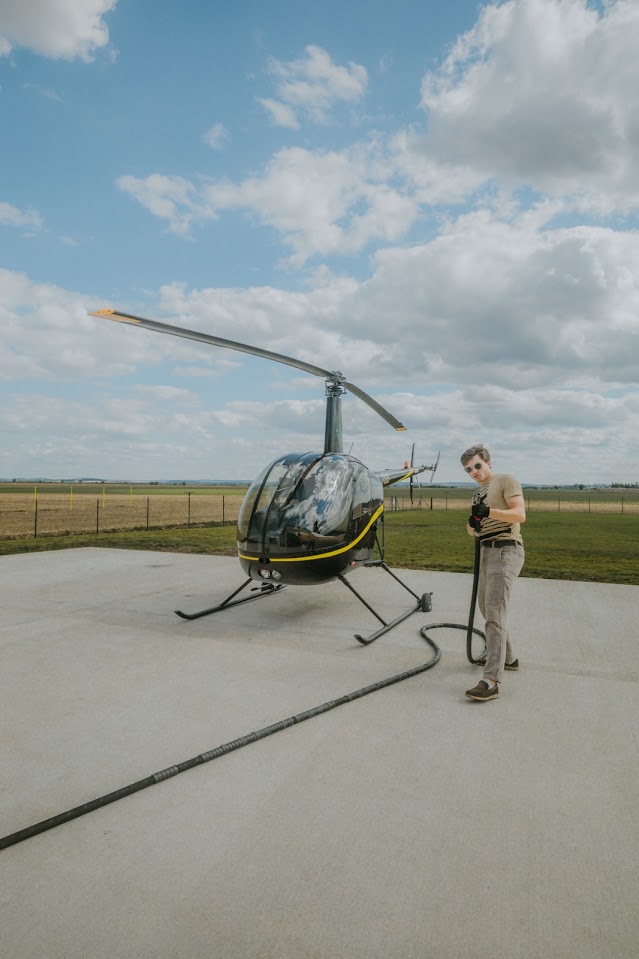
Vaclav refuelling the helicopter on the pad
HOW IT WORKS

Shared-cost flying in essence

01

Private aviation, not commercial.

This is not a commercial sightseeing service or public transport. The pilot holds a private PPL(H) licence and offers seats only on flights he chooses to make. Passengers do not buy a scheduled seat or the protections associated with commercial air transport.

02

The pilot decides. 

The pilot in command has the final and complete authority over the aircraft and flight. Route, timing, loading, fuel, weather minima and whether the flight goes ahead are pilot's operational decisions. A passenger request or even taunting never override pilot's responsibility. The passengers must respect pilot's instructions.

03

Honest about risk.

Flying privately in a small aircraft can carry a higher risk of accidents or incidents than travelling with a commercial airline. That is not meant to scare you, only to make sure you decide with the full picture. The Norwegian Civil Aviation Authority (Luftfartstilsynet) asks every small-aircraft passenger to know this, and so do I.

04

Airmanship on every flight.

To keep the risk as low as possible, weather, wind, the helicopter and the pilot’s own fitness to fly are checked and double-checked before each flight. Pilots call this airmanship, the same mindset as respecting the sea or the mountains. There is no shame in turning back: if anything is not as it should be, we stay on the ground, change the route or return.

05

Recent experience - just ask.

To carry passengers, a pilot must have made at least three take-offs and landings within the previous 90 days. I meet this requirement before every passenger flight, and you are warmly encouraged to ask how much I have flown recently. A good pilot is happy to answer.

06

A certified, maintained helicopter.

 The Robinson R44 Raven II is a factory-built, type-certified helicopter, maintained under an approved maintenance programme.

07

No profit.

Shared-cost flying is based on eligible direct expenses of a specific flight (e.g. fuel, airfield charges and aircraft rental) being shared by everyone on board, including the pilot. The activity does not generate any profit to the pilot. The final calculation is confirmed after the flight based on the actual flight time.

08

What the estimate means.

The figures shown on each trip are illustrative estimates based on duration and group size. One passenger contributes 65%, two contribute 75% in total, and three contribute 85% in total, with the pilot covering the remainder. These are not commercial fares or binding quotes.

09

Weather is part of flying.

Norwegian conditions change quickly. Expect roughly 20–40% of planned flights to be cancelled or rescheduled as an honest operational expectation (being worse in the autumn and winter months). Low cloud, wind, visibility or other factors may stop a flight even at short notice. The pilot may decide to divert or abort the flight mid-air if the conditions deteriorate unexpectedly.

010

Weight and balance.

Every passenger provides an approximate weight before approval. The individual seat limit is 130 kg.  Combined passenger weight, fuel, baggage, weather and aircraft limits are calculated for every flight. Pack light and answer accurately.

011

After you enquire.

An enquiry expresses interest only. The pilot reviews availability, the intended route, weather outlook, aircraft status and passenger weights. Only a direct confirmation creates an agreed plan. No online payment is taken through this website. Preferred payment method is Vipps or Revolut on spot.

NORWEGIAN CIVIL AVIATION AUTHORITY

Flying as a passenger in a small aircraft?

Take three minutes before your flight to watch the authority’s short video and advice on the risks of flying in small aircraft (in Norwegian).

Read & watch
ASK FIRST

Still curious?

Plan a flight